Posts

Showing posts with the label Fuzzy Logic & Soft Computing

Fuzzy Inference Methods

Image
After learning Fuzzy Inference System Overview, let's go towards the learning of Fuzzy Inference Methods. If you haven't gone through it, just click below for that. Click here to get an overview of FIS:   "  Fuzzy Rule-Based System  " Methods of FIS: Mamdani Fuzzy Inference System Takagi - Sugeno Fuzzy Model (TS Method)  Mamdani Inference System This System proposed by Ebhasim Mamdani in 1975 . It was anticipated to control a steam engine and boiler combination by synthesizing a set of fuzzy rules obtained from people working on the system. Mamdani Fuzzy Inference System   Steps need to be followed for computing output of the FIS: Determining a set of fuzzy rules Fuzzifying the inputs using the input membership functions Combining the fuzzified inputs according to the fuzzy rules to establish a rule strength Finding the consequence of the rule by combining the rule strength and the output membership function Combining the consequences to get an output distribut...
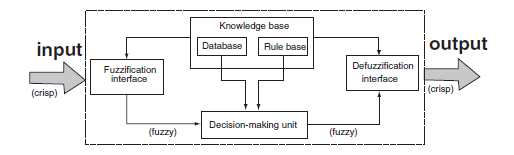
Fuzzy Rule-Based System

Image
It is easy for us to express our views in our natural language so that it becomes easy to understand rather than talking in boolean. Comparing ourselves even Fuzzy logic has the same significance in expressing conditional statements. The expression for the representation is given below - IF antecedent THEN consequent  The expression as stated above is referred to as the Fuzzy IF-THEN rule base . Canonical Form This is a representation of a system, for a given condition if true a number of restrictions have to be obeyed. Following is the canonical form of Fuzzy Logic Rule Base Rule 1 - If condition C1, then restriction R1 Rule 2 - If condition C1, then restriction R2 . . . . Rule n - If condition C1, then restriction Rn. There are three general forms in which the canonical rules can be formed. They are: 1. Assignment Statements 2. Conditional Statements 3. Unconditional Statements let's learn it one by one. 1.  Assignment Sta tements These kinds of statements use " = " (e...

Classical and Fuzzy Set Theory

To begin this article, First let me tell you the difference between the Classical Set theory and Fuzzy Set Theory. Classical Set Theory Fuzzy Set Theory 1. This theory is a class of those sets having sharp boundaries. 1. This theory is a class of those sets having un-sharp boundaries. 2. This set theory is defined by exact boundaries only 0 and 1 2. This set theory is defined by ambiguous boundaries. 3. In this theory, there is no uncertainty about the boundary's location of a set. 3. In this theory, there always exists uncertainty about the boundary's location of a set. 4. This theory is widely used in the design of digital systems. 4. It is mainly used for fuzzy controllers. Set  A set is a term, which is a collection of unordered or ordered elements. Following are the various examples of a set:  A set of all-natural numbers A set of st...

Fuzzy Logic Introduction & its Applications.

Image
This concept was introduced by Lofti Zadeh in 1965 based on the Fuzzy Set Theory. This concept provides the possibilities which are not given by computers, but similar to the range of possibilities generated by humans.  In the Boolean system, only two possibilities (0 and 1) exist, where 1 denotes the absolute truth value and 0 denotes the absolute false value.  Fuzzy means the things that are vague or not clear. Sometimes,  we cannot decide in real life that the given problem or statement is either true or  false. Because  there are multiple possibilities present between the 0 and 1, which are partially false and partially true.  At that time, this concept provides  many values between the true and  false  and gives the flexibility to find the best solution to that problem. Characteristics  of Fuzzy Logic System This concept is flexible and we can easily understand and implement it. It is used for helping the min...