Posts

Showing posts with the label Advanced Control Theory

RGA & Selection of control loops

Image
In last blog we learned about how we can get Relative Gain Array by two stages. If you haven't gone through yet, click below link: Multi-variable System In this blog, we will analyze different conditions for Relative Gain Array. RGA provides a quantitative criterion for for selection of control loops that would lead to minimum interaction among the process. Direct & Indirect Effects of control loop interaction Let us open the loops and detach the controllers from the process. Let us keep u2  constant and introduce step input in u1 . That would yield a static gain and indicate direct effect of input on output. Let us now close only the loop 2 and attach the corresponding controller with the process. Let us now introduce a step input in u1 while maintaining y2 at its desired setpoint through the loop 2 controller. That would yield another open loop gain and indicate direct as well as indirect effect of u1 on output y1 . Let's analyze the following conditions for RGA: D...

Multi-variable System

Image
What is Multi-variable System? As name suggests, multi-variable means multiple parameters included in system. The control system which have more than one input & more than one output, which is called Multi-variable System .  This kind of system have as many inputs and outputs as needed to control the process. In multi-variable system, the interaction in between variables are very strong. If any disturbance occurred, then response of the system will change. The changes in signal path can be in two way, direct & indirect. Let's learn it with example; Example of Process As above shown, consider the process having two inputs u1, u2 and two outputs y1, y2. Suppose if any kind of change occurred in input u1, it may have two effects. Changes in output y1 ( Direct effect ) via measured value interaction Changes in output y2 ( Indirect effect ) via control loop interaction This process interaction cause potential problems in systems; It will destabilize the closed loop system T...

Digital Implementation of PID Controller

Image
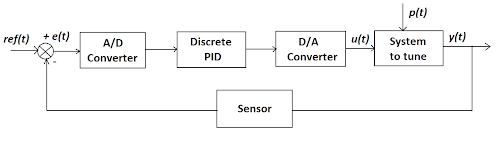
The implementation of the PID controller has evolved from early mechanical and pneumatic designs to analog circuits using transistors, and lately to the microprocessor and digital systems. The digital PID so designed is based essentially on architectures including multipliers, adders, and some other logic circuits. Another advantage of digital control is that the error signal is first sampled and the controller output is computed numerically through a digital processor. Control action = past control action + correction by controller  For PID controller Lets consider the following diagram   Input = e(t)   Output = u(t)    The transfer function in the PID controller in continuous time is given by Equation 1 Where k= gain Ti = integral time Td = derivative time Taking Laplace to transform on both sides we obtain the continuous controller Equation 2 Write the above equations in gain terms Equation 3 To implement in digital write Equation 3 in z – transform...

Root locus for Discrete Time Systems stability.

Image
The root locus method can also be used for discrete-time systems without many modifications since the characteristic equation of a discrete control system is of the same form as that of a continuous-time control system. In many LTI discrete time control systems, the characteristics equation may possess any of the below 2 forms. 1 + G(z)H(z) = 0 1 + GH(z) = 0 To combine both, let us define the characteristics equation as: 1 + L(z) = 0 ----------(1) where,L(z) = G(z)H(z) or L(z) = GH(z).  L(z) is popularly known as the loop pulse transfer  function. From equation (1), we can write L(z) = −1 L(z) is a complex quantity that can be split into two equations by equating angles and magnitudes of two sides. This gives us the angle and magnitude criteria as Angle Criterion:  ∠  L(z) = ±180 ° (2k + 1), k = 0, 1, 2.... Magnitude Criterion :  |L(z)| = 1 The values of z that satisfy both criteria are the roots of the characteristics equation or close loop poles. Before const...